

Forklift operator staffing dallas tx breaks down when a resume says “certified” and the first pallet still tips in your aisle. Dallas warehouses, cross-docks, and plants run sit-down trucks, reach trucks, order pickers, and pallet jacks on tight shifts. A card from another site does not prove the person can run your truck, on your floor, on your schedule. This guide shows how to staff those seats: what to ask for, how to verify it, and how to get a safe first shift.
Request a forklift staffing consultation
Tell Eclipse which trucks and shifts you need filled.
What Dallas employers should define before the first candidate call
Start with the seat, not a generic “forklift operator” title. A South Dallas fulfillment site and a Lancaster manufacturing dock can both post that title and need two different people. Write the order the way a supervisor would hand off a shift.
Name the truck class, the attachment, and the rack height. Sit-down counterbalance work is not reach-truck work. A clamp attachment, a slip-sheet, or a narrow aisle changes who is actually qualified. Note whether the operator stages trailers, picks cases, or feeds a production line.
Then lock the shift facts. First, second, and weekend crews draw different candidate pools across Dallas-Fort Worth. Say whether overtime is expected, whether the role is temporary, temp to perm, or direct hire, and which building the person will report to. Vague orders produce no-shows.
Add the conditions that change risk. Coolers, outdoor yards, pedestrian traffic, and ramps all belong on the order. So does the language the team uses on the floor. Eclipse Light Industrial Staffing works this South Dallas and Northern Ellis County footprint every day, from Lancaster and DeSoto through Hutchins, Wilmer, and Waxahachie. A local order is easier to fill than a statewide one.
| Order detail. | Why it changes the match. | What to send the staffing partner. |
|---|---|---|
| Truck and attachment. | Prior training counts only if it fits this truck. | Class, model family, clamp or standard forks, and max lift height. |
| Shift and site. | Commute and crew pattern drive show-up. | Address, start time, days, overtime, and indoor or yard work. |
| Work mix. | Picking, dock, and line feed are different jobs. | Share of time on each task and the pace expected. |
| Hire path. | Seasonal coverage and a permanent seat need different offers. | Temp, temp to perm, or direct hire, plus conversion timing. |
If the building is new, pair this order with a broader ramp plan. Our guide to staffing a new distribution center covers the roles around the forklift seat. The operator order itself should still stay this specific.
How to verify forklift experience before anyone drives
Treat “certified forklift operator” as a claim, not a clearance. Ask where the person last drove, which truck, and for how long. A year on a stand-up reach truck does not equal a year on a sit-down in a trailer.
Eclipse uses a 4-step screen. It covers a phone screen, a task-based check, a culture-fit read, and a full review before the person is offered to you. For forklift seats, that task check should include the truck you named, not a generic warehouse test. Skill-based screening for light industrial roles is the same idea applied across the floor.
Ask the staffing partner for four kinds of evidence you can file with the order:
- The truck types the person has operated, with rough dates and site types.
- Any prior evaluation that names the trainer and the date.
- Work limits you care about, such as no yard work or no high-reach.
- Identity and work-authorization checks, including E-Verify where you require it.
Skill Check assessments can add a job-specific, cognitive, or behavioral read when the seat needs more than seat time. They do not replace a driving evaluation on your equipment. Use them to spot judgment and learning issues before the on-site test, not after a near miss.
Second-chance hiring still fits this seat when the record and the role line up. Review background findings case by case. A past issue is not an automatic no, and it is not an automatic yes on a powered truck. Put the decision in writing so the next supervisor sees the same standard.
Send Eclipse your truck list and shift pattern.
Site training still belongs to the host employer
A staffing firm can recruit and pre-screen. It cannot certify your building by handing you a wallet card. Federal rules for powered industrial trucks require a competent operator before anyone drives, other than as a trainee. Competence is shown by the training and evaluation in the rule. The rule is 29 CFR 1910.178.
Training has three parts: formal instruction, practical practice, and an evaluation in the workplace. Trainees may drive only under a qualified person and only where the practice does not put other people at risk. Someone with the knowledge and experience to judge competence has to run both the training and the evaluation.
Prior training can count. If the operator was already trained on a topic that matches your truck and your conditions, you do not have to repeat that topic. You still have to evaluate the person and find them competent on your truck. That is the step many Dallas sites skip when a temp arrives with a card from a previous host.
Content has to cover the truck and the workplace. Truck topics include controls, visibility, capacity, stability, and the inspection the operator will actually do. Workplace topics include the surface, ramps, narrow aisles, pedestrian routes, and anything hazardous in that building. A smooth new floor in Wilmer is not the same test as an older dock in Oak Cliff.
Keep the certification the rule describes. It should name the operator, the training date, the evaluation date, and the person who performed them. Refresh after unsafe driving, an accident or near miss, a failed evaluation, a move to a different truck, or a workplace change that affects safe driving. Evaluate each operator at least every three years even when nothing goes wrong.

Host employers and staffing firms should also write down who trains, who reports injuries, and who keeps records. Texas manufacturing staffing safety compliance covers the wider temporary-worker program. This page stays on the truck seat. NIOSH has urged host employers to spell out training and injury reporting for temporary workers in the contract. Split employment is where that responsibility gets fuzzy.
Match the operator to the assignment, not just the opening
Verification gets you a capable driver. Assignment fit gets you a stable shift. The miss usually shows up in week two, when the person can drive but will not stay on that schedule or that building.
Compare the candidate with the order on four points: truck, pace, shift, and supervision. A careful reach-truck picker can be the wrong hire for a fast dock that stages live trailers. A strong dock operator can be the wrong hire for a high bay with tight aisles. Say this out loud in the handoff so the supervisor is not surprised at 6 a.m.
Choose the employment path on purpose. Temp to perm staffing lets you watch real work before you hire. Eclipse uses a 520-hour evaluation window on that path so both sides see attendance, pace, and safety habits. Seasonal staffing fits a peak, a remodel, or a short customer program. Direct hire fits a seat you already know you will keep. Payroll and employer-of-record support fits when you have the person and need the employment handled.
Do not shop this decision on a posted hourly rate. Pay moves with shift, truck, and site, and Eclipse prices the service in a consultation rather than from a rate card. What you can compare in advance is coverage. Look at backfill speed, who evaluates skill, and what you owe if the first person is not a fit.
Our guide to interviewing warehouse workers helps with general floor hires. For a forklift seat, add a short observed drive. Ten careful minutes on your aisle tells you more than another interview question.
A first-week onboarding sequence that protects the shift
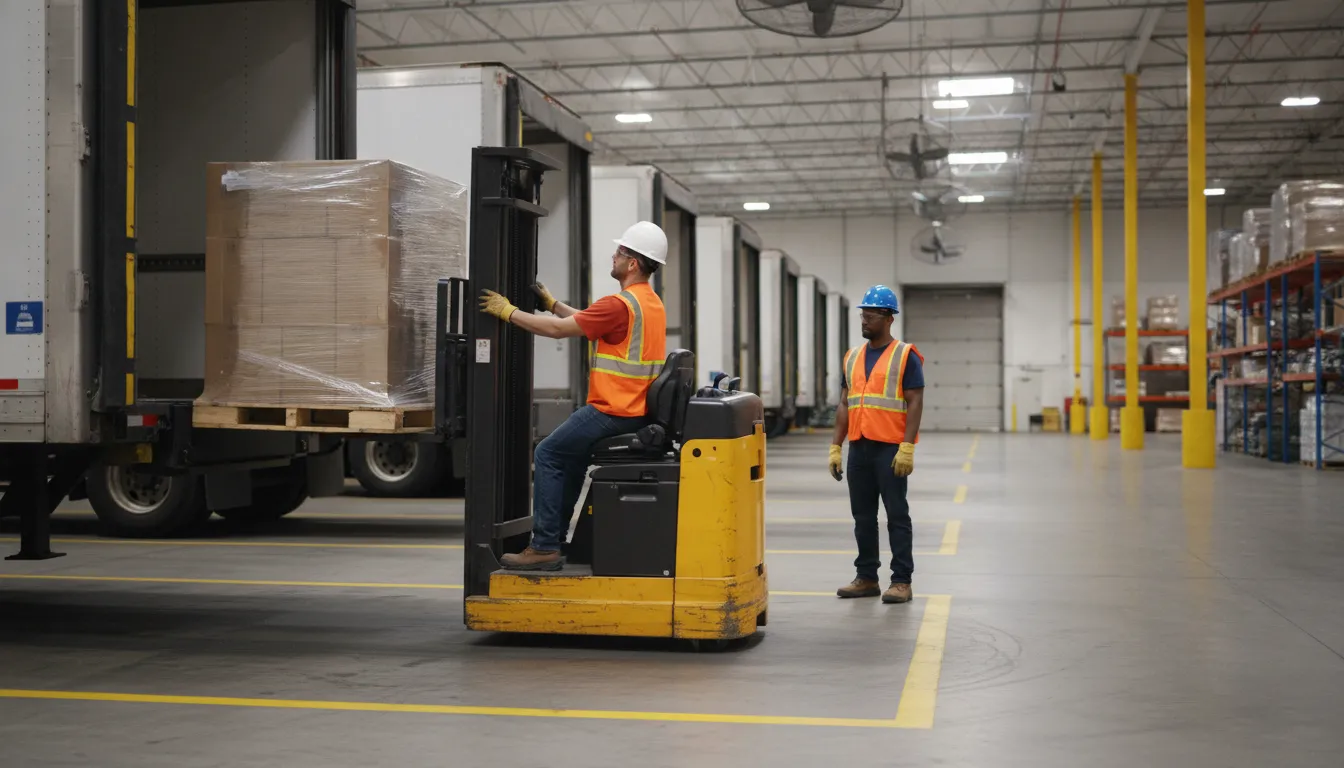
Operators leave when day one is chaos. Build a short sequence and use it every time, including backfills. The goal is a named trainer, a finished evaluation, and a supervisor who knows the limits.
- Confirm the order: truck, shift, building, and hire path, before the person is dispatched.
- Send a start packet with the address, parking, report-in name, boots, and vest rules.
- On arrival, check identity, complete site orientation, and walk pedestrian routes.
- Review the truck the person will use, including capacity, attachments, and the daily check.
- Run formal instruction only on topics their prior training does not already cover.
- Observe a supervised drive in the real aisle, then evaluate and record the result.
- Assign the first shift only after that evaluation. Name the lead who can pull them off the truck.
- Check attendance and near misses at the end of week one, and decide on a backfill early.
Keep the trainer off the clock as “extra help.” If the only qualified evaluator is also running a dock, the evaluation gets waved through. That is how an uncertified operator ends up in a trailer.
Write the backfill rule in the staffing agreement. If the person cannot pass the evaluation, or misses shift two, you should not restart from a blank resume. A light industrial staffing contract checklist is a useful cross-check for those terms.
On-site leads help when you are covering several buildings. On-site management keeps a coordinator where the trucks are. That matters more for forklift seats than for general labor, because the evaluation cannot be done from an office.
Where forklift operator staffing Dallas TX should start
Forklift operator staffing in Dallas, TX works best when the partner already knows the buildings south of downtown and into Ellis County. Eclipse is a light industrial firm based in that market. Recruiters screen before the client call, and they keep a bench for warehouse, logistics, transportation, and manufacturing seats.
Use the service line that matches the seat. A multi-role warehouse need belongs with warehouse staffing in Dallas. Transportation yards and driver-adjacent docks belong with transportation staffing across Dallas-Fort Worth. If you are comparing firms, start with how to choose a staffing agency for warehouse operations, then ask each one who evaluates the truck.
People looking for a seat, rather than trying to fill one, should use a different page. Forklift operator jobs in South Dallas and the job opportunities board are built for applicants. Employers who want a plan for their own floor should come through the consultation, not the apply button.
Book a consultation for your next operator seat.
Frequently asked questions
Does a forklift card from another Dallas site let someone drive on day one?
No. Prior training can shorten what you repeat. You still have to evaluate the operator on your truck and in your workplace before they work unsupervised. Record the evaluation date and the person who signed it.
Who provides forklift training, the staffing agency or the host site?
The host employer has to ensure competence under 29 CFR 1910.178 before operation. A staffing partner can recruit, pre-screen, and coordinate a qualified trainer. Put the split in the contract so neither side assumes the other did the evaluation.
How is temp to perm different from a seasonal forklift assignment?
Temp to perm is a try-before-you-hire path, with a real-work evaluation before conversion. Seasonal coverage is built to end when the peak ends. Use direct hire when you already know the seat is permanent and you do not need a trial.
What should we send a staffing partner for forklift operator staffing in Dallas, TX?
Send the truck type, attachments, shift, building address, work mix, and whether you want temp, temp to perm, or direct hire. The more specific the order, the fewer mismatched drivers you will see on day one.
Can Eclipse fill operator seats outside central Dallas?
Yes. Day-to-day coverage includes Lancaster, DeSoto, Duncanville, Cedar Hill, Hutchins, Wilmer, and Oak Cliff. It also includes South Dallas and Ellis County cities such as Waxahachie, Ennis, Midlothian, and Ferris. Name the exact site so commute and shift fit get screened up front.
