
Managing employment taxes, worker safety paperwork, and payroll administration distracts small manufacturers from hitting their daily production targets. When payroll issues or compliance errors occur, they quickly eat into your narrow operating margins. Many small shop owners spend more time in the back office than managing their teams on the assembly line.
An employer of record is a professional third-party partner that becomes the official legal employer of your staff while you maintain day-to-day control of your plant floor. Under this business arrangement, the service provider takes over all payroll administration, employment tax filings, workers compensation claims, and local regulatory compliance. The provider handles human resources tasks and offers robust employee benefits, which helps you recruit and retain skilled technicians in competitive markets. By acting as the legal employer, the EOR shields your business from regulatory liabilities and costly payroll mistakes without requiring you to hire internal HR administrators. This protective partnership lets you focus entirely on your core manufacturing processes.
See Our Employer of Record Services today and simplify your workforce management.
Understanding how an employer of record works is the first step toward reducing your daily office workload and securing your factory from costly legal fines. This article is part of our complete guide to how light industrial staffing works, covering the full range of workforce solutions for DFW employers. Let us look at what this service handles and how it can help your business thrive in the local Dallas-Fort Worth market. We will start by looking at the official definition of What Is an Employer of Record (EOR)?
What Is an Employer of Record (EOR)?
An employer of record is an outside organization that serves as the legal employer for your staff. When you use this service, the provider takes on all legal tasks and risks for your workers. This includes payroll, tax filings, and benefits. But even though the provider is the legal employer, your company keeps day-to-day control over the work. You guide the team, set their tasks, and manage their daily output on your manufacturing floor.
How EOR Works for Your Business
An employer of record service lets you hire workers without setting up a new business entity. This is very helpful when you want to hire in a new state or region. The provider handles your tax accounts, local registrations, and insurance needs. Your workers become W-2 employees of the provider, but they perform tasks under your direction. This setup keeps your business compliant with local tax laws. For detail on how the federal government views these relationships, you can review the guidelines from the Internal Revenue Service.
Day-to-Day Tasks Versus Legal Liability
Under this arrangement, there is a clear split between management tasks and legal duties. Your company manages the actual work. You decide what the workers do, when they do it, and how they do it. The provider manages the administrative tasks. They handle the payroll, distribute wages, withhold taxes, and issue W-2 forms at the end of the year. They also handle workers’ compensation insurance and state unemployment claims. This split lets you focus on your core business while reducing your legal risks.
Difference From a Temp Agency
Many business owners confuse an employer of record with a traditional temp agency. A temp agency typically recruits, screens, and places workers for short-term projects. An employer of record does not always recruit the workers. Often, you find the talent yourself and refer them to the provider. The provider then hires them on their payroll. This makes the service a great fit for long-term workers, seasonal staff, or when you want to test a worker before a permanent hire.
How Does an EOR Differ From a Staffing Agency?
Many business owners confuse an employer of record (EOR) with a traditional staffing agency or a professional employer organization (PEO). While all three models help you manage your workforce, they operate under different legal structures. Choosing the wrong setup can expose your company to major compliance risks and unexpected overhead costs.
Legal Employer vs. Recruiting Partner
A traditional staffing agency focuses on sourcing and recruiting talent to fill immediate openings. Once the agency places a worker at your facility, you typically hire them onto your payroll or pay the agency a flat rate for temporary staff. In contrast, an EOR acts as the full legal employer of your workers. The EOR handles all back-office tax and legal tasks, while you maintain direct day-to-day control over their work on the production floor.
Co-Employment vs. Full Delegation
A PEO uses a co-employment model, which means you and the PEO share legal employer liabilities. To use a PEO, you must register your own tax entities in each state where your workers live. An EOR avoids this hurdle by taking on 100% of the legal employer status under its own federal tax identification number. This allows you to hire and pay workers across different regions without setting up local tax accounts or business entities.
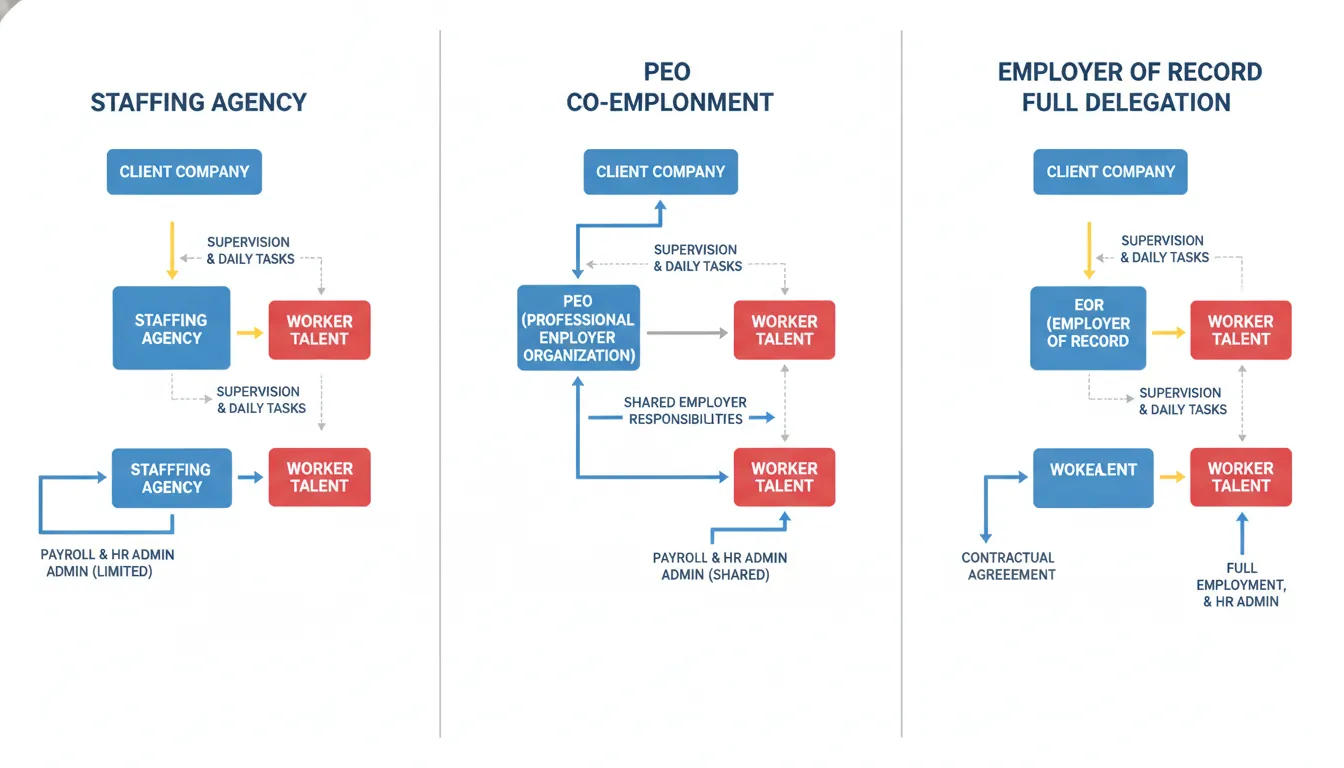
| Feature | Staffing Agency | Professional Employer Org (PEO) | Employer of Record (EOR) |
|---|---|---|---|
| Legal Employer | The agency (for temporary staff) or the client | Shared (Co-employment model) | The EOR partner (100% legal employer) |
| Tax Entity Needed | No (for agency temps) or Yes (for direct hires) | Yes (client must register in each state) | No (uses the EOR’s tax accounts) |
| Workforce Sourcing | Primary service (finds and screens candidates) | No (only manages your existing staff) | No (manages staff you select or transition) |
| Workers’ Comp Policy | Held by agency for temporary placements | Shared or client-provided policy | Provided directly under the EOR policy |
| Daily Supervision | Managed by the client on-site | Managed by the client on-site | Managed by the client on-site |
Understanding the Regulatory Landscape
Labor laws vary greatly between temporary placement and employee leasing. Government bodies like the State of Oregon Workers’ Compensation Division require strict records to distinguish temporary staffing from employee leasing. Misclassification can lead to civil penalties, unpaid insurance claims, or worker auditing. An EOR keeps your business safe by managing all employment files, payroll taxes, and workers’ compensation coverage in strict compliance with state regulations.
What Does an EOR Handle for Your Business?
Managing a manufacturing plant or a warehouse in the Dallas-Fort Worth metroplex demands constant attention to parts, schedules, and shipments. It leaves very little time to manage complex labor paperwork or track changing employment laws. When you partner with an payroll and EOR services provider, they take on the legal duties of employment. While you still direct the daily tasks and work schedules of your team on the floor, the provider manages the heavy administrative work behind the scenes. This setup is highly useful for small manufacturers who need to focus on production and growth rather than back-office payroll tasks. Talk to our team about how EOR services can streamline your payroll and compliance workload.
Complete Payroll Processing and Tax Filings
An employer of record makes sure your workers get paid on time. They keep your business in line with complex tax rules. They handle weekly or biweekly wage distribution and manage all federal, state, and local tax withholdings. Under the tax guidelines defined by the Internal Revenue Service, the EOR acts as the statutory employer for tax purposes. They handle tax filings, process annual W-2 forms, and manage state unemployment insurance claims. This legal setup shields your business from costly payroll mistakes and tax penalties.
Comprehensive Benefits Administration
Offering good benefits is key to keeping skilled shop workers. However, managing these plans is often too hard for a small human resources team. An EOR solves this by giving your staff access to pre-established benefit packages. They handle health insurance enrollment, retirement savings plans, and paid time off tracking. Because the EOR acts as the official employer, they also manage workers’ compensation policies and claims. This is highly useful for manufacturing and logistics firms where workplace safety and injury management require daily oversight.
Strict HR Compliance and Legal Support
Navigating state and federal employment laws can be a legal minefield for expanding businesses. An EOR monitors changes in labor laws, family leave policies, and civil rights mandates to keep you safe from legal risks. They oversee mandatory background checks, coordinate drug screening, and process strict E-Verify checks during hiring. If you need to scale up your shop workforce, they can also help you hire temporary warehouse workers quickly without adding to your in-house HR workload.
Reduction of Admin Overhead
By outsourcing these tasks, small plant owners can cut down on HR overhead costs and administrative stress. Instead of hiring a full-time HR manager to track hours, benefits, and taxes, you pay one clear fee to your EOR partner. This allows you to allocate your tight budget to equipment, raw materials, or sales efforts. The EOR handles onboarding, manages worker files, and resolves wage disputes. This leaves your core team free to focus entirely on hitting your daily production goals.

When Does It Make Sense to Use an Employer of Record?
Managing workers takes time and care. For small plant owners in the Dallas-Fort Worth metroplex, administrative work can slow down production. Hiring an EOR with temp to perm staffing capabilities lets you focus on making products while a trusted partner handles the legal duties of employment.
Growth and Hiring Needs
Working with an EOR is a strategic choice. It helps you manage your workforce without the stress of extra office work. Here are five times when using an EOR makes sense for your business.
- Scaling Teams Without New Entities Setting up a legal entity in a new state is slow and costs a lot of money. If you need to hire remote workers or set up a small satellite team outside of Texas, an EOR is the fastest path. The EOR already has legal structures in place, which lets you hire workers legally in days instead of months.
- Managing Seasonal Production Surges DFW manufacturers in towns like Lancaster and DeSoto often face busy seasons. Handling payroll and tax forms for a large group of short-term workers can overwhelm your HR staff. Using seasonal staffing through an EOR keeps your team size flexible and protects your core staff from burnout.
- Reducing HR and Legal Overhead for Small Teams Small businesses often do not have full HR or legal teams. Managing workers compensation, state tax laws, and payroll takes hours. An EOR acts as the legal employer, which transfers these administrative risks away from your business. You still manage day-to-day work, but the EOR handles the legal details.
- Accessing Benefits for a Small Workforce It is hard for small teams to buy cheap health insurance and retirement plans. An EOR groups many workers together to get better rates. This lets you offer great benefits to your team, which helps you hire top local talent in Ellis County and South Dallas.
- Testing New Staffing Models Safely Many local businesses want to try out workers before offering them a permanent job. Using temp to perm staffing with an EOR lets you see a worker’s skills on the job. This lowers your hiring risk and ensures a good fit for your shop floor.
Ensuring Legal Compliance
Labor laws change often. The U.S. Department of Labor enforces strict rules about pay, overtime, and safety on the job. An EOR tracks these rules to keep your business safe from fines. By letting an expert handle compliance, you protect your company from costly court cases and state audits.
How to Choose an EOR Provider in DFW
Selecting the right EOR provider is a critical choice for local manufacturers. The ideal partner must understand the unique demands of the Dallas-Fort Worth industrial market while managing complex payroll and tax tasks. To understand how this fits into your broader staffing strategy, read our complete guide to how light industrial staffing works. A strong local provider lets you focus on production while they handle employment liabilities and regulatory risks.
Prioritize Local Market Knowledge and Specialization
A national EOR firm often lacks insight into the local DFW labor landscape. A provider with deep regional roots understands the local talent pools and wage expectations in hubs like Lancaster, DeSoto, and Waxahachie. To ensure your production lines stay staffed, choose an EOR partner with a proven history in industrial staffing. At Eclipse, we have spent 15 years serving DFW and focus over half of our placements on manufacturing roles. For more details on our local roots, you can read About Eclipse.
Demand Rigorous Candidate Screening
Your EOR provider must supply skilled, reliable workers who can keep up with your production schedules. Ask potential providers about their testing and onboarding methods. A reliable partner will use structured, job-specific tests to verify skills before placement. We perform a thorough 1.5-hour screening that includes over 500 Skill Check assessments from Symphony Talent. This ensures every worker placed on your floor has the exact skills and safety awareness needed for the job.
Check for WBE Certification and Diversity Programs
Many major clients require their suppliers to meet specific diversity goals. Partnering with a Woman-Owned Business Enterprise (WBE) helps you meet these targets and win more corporate contracts. When you screen DFW providers, ask for their official certifications. Choosing a certified EOR partner allows you to fulfill your commercial diversity needs without sacrificing service quality or compliance standards.
Confirm Compliance Practices and Inclusive Hiring
Your EOR partner must maintain strict legal standards to shield your business from costly labor disputes. Ensure they use robust verification tools like E-Verify. The U.S. Citizenship and Immigration Services (USCIS) manages this online database to confirm employment eligibility. Additionally, look for a partner who practices second-chance hiring by evaluating candidates with past records on a case-by-case basis. This inclusive approach expands your talent pool and supports local communities in South Dallas and Ellis County.
Frequently Asked Questions
What does an employer of record do?
An employer of record acts as the legal employer for your staff. This partner handles payroll processing, issues tax forms like W-2s, administers benefits, and manages workers compensation claims. While they manage these legal and back-office tasks, your business retains full day-to-day control over the work and productivity of your team.
How does an employer of record differ from a PEO?
A Professional Employer Organization operates under a co-employment model where both your business and the PEO share legal employment liabilities. An employer of record takes on the entire legal liability for the workers. This setup protects your business from complex labor law compliance issues and is ideal if you want to avoid co-employment risks.
When should a business use an employer of record?
You should use this service when you want to hire workers in a new city or state without setting up a new business entity. It is also highly useful for short-term projects, seasonal manufacturing surges, or when you want to outsource payroll and benefits management. This approach allows you to focus on daily operations rather than HR tasks.
Does an employer of record handle payroll and benefits?
Yes, they take on full responsibility for both areas. This includes calculating and distributing wages, handling payroll tax withholdings, and filing local tax forms. They also offer workers access to key benefits like health insurance, retirement plans, and paid time off. By managing these tasks, they reduce your in-house administrative work.
Who is the legal employer in an EOR arrangement?
The service provider is the sole legal employer of the workers. They assume all compliance responsibilities, handle tax filings, and manage insurance requirements under local laws. However, your managers still direct the daily tasks and schedule of the employees. This division lets you run your shop while the partner manages legal risk.
Ready to Simplify Your Workforce Management?
Managing payroll, taxes, and labor laws takes your focus away from production targets. As a certified women-owned business with over fifteen years of Dallas-Fort Worth manufacturing expertise, Eclipse relieves this administrative burden. We handle your employment risk, worker benefits, and payroll duties while you maintain direct control over your facility operations.
Do not let compliance details slow your business growth down. Our team helps you scale up or down smoothly while keeping your light industrial operation fully compliant. Ready to simplify? Call (972) 685-7800 to schedule a consultation about Employer of Record services for your manufacturing business today.
